|
Monthly Update · September 2026
The One About Money Coming In
Hi there — it's Paul. Last month was the double feature. This month is shorter and has a theme: the money-in side of your books. Donors who'd rather give from their bank account than a card, the 1099 pile that ambushes every treasurer in January, and membership dues where part of the check isn't really yours. All three got a lot easier in the last few weeks.
|
|
|
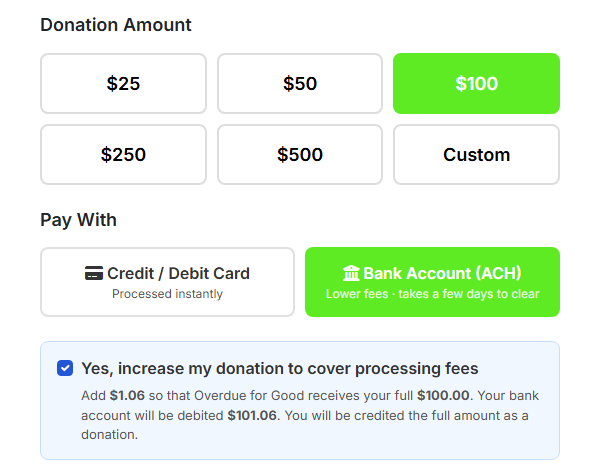
Let Donors Give Straight From Their Bank Account
Your donation page can now take bank account (ACH) payments alongside cards. Why you'd want that: the processing fee on a card gift is 2.9% plus 30¢, while a bank-account gift is 0.8% capped at $5. Both carry the same GoodBooks platform fee of 0.25% (plus $1 per gift on the Free plan). On a $1,000 year-end gift that's the difference between about $32 in fees and $7.50. Donors pick their bank from a list and verify instantly, or type in routing and account numbers and confirm two small deposits a couple of days later — GoodBooks walks them through either way.
Bank gifts show up in your books as ACH Processing until the payment clears (about four business days), and the receipt goes out when it does, so nobody gets thanked for money that bounced. It's one switch under Online Payments, and it works on membership renewals and invoice pay links too.
|
|
|
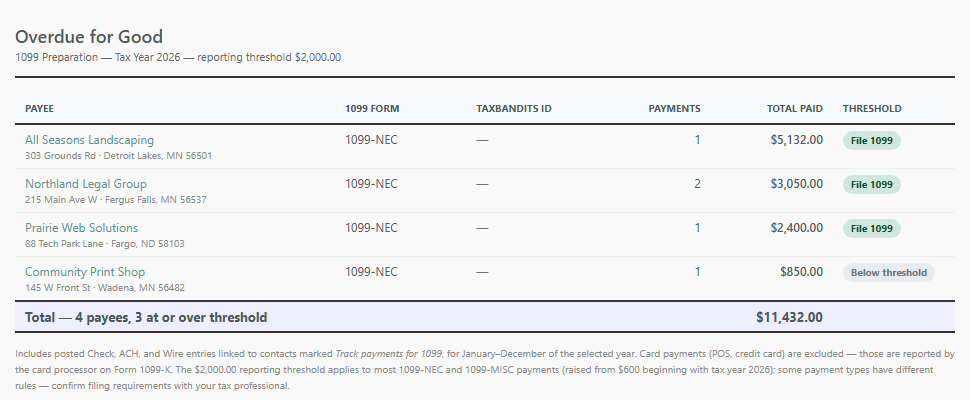
1099s, Sorted in September Instead of January
Flip on Track payments for 1099 for any contractor, landscaper, or attorney you pay, pick which form applies, and GoodBooks does the rest. The new 1099 Preparation report (Foundation plan and up) totals every check, ACH, and wire payment to those payees for the calendar year and tells you who's over the reporting threshold — which, heads up, is $2,000 starting with tax year 2026, up from $600. Card payments are left out on purpose, since the card processor reports those. One click exports the whole thing to a spreadsheet for your accountant or e-file service.
Do the flagging now while it's ten minutes of work. In January it's an afternoon.
|
|
|
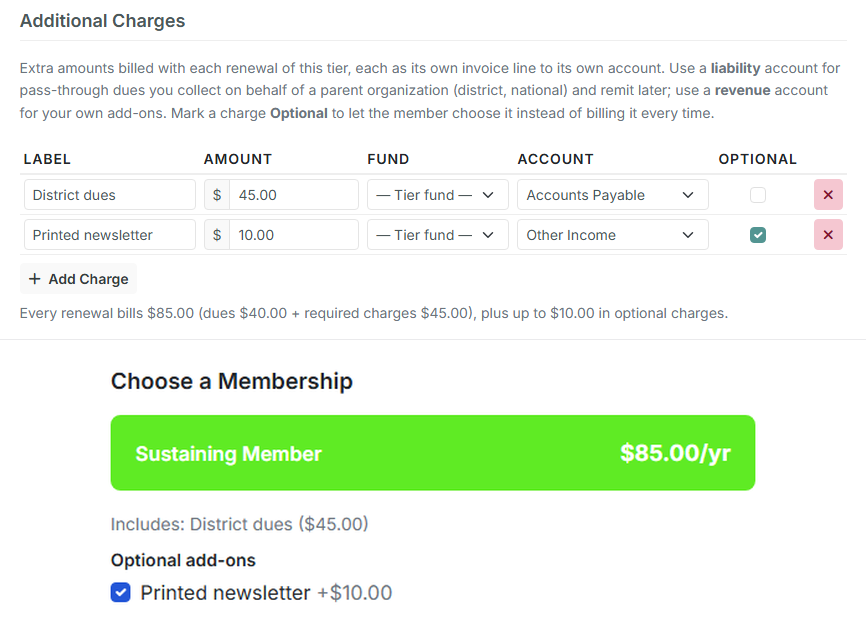
Membership Dues That Know Where Every Dollar Goes
If you're a Rotary, Lions, Kiwanis, or any club that collects district or national dues along with your own, you know the problem: a member writes one $85 check, but only $40 of it is yours. The other $45 belongs to the district, and booking it as revenue means fixing it later. Membership tiers can now carry additional charges, each posting to its own account — a liability account for the pass-through, so it sits there until you remit it, or a revenue account for your own add-ons. Mark a charge optional and members choose it themselves.
The split follows the member everywhere: the add-member form, renewals, the automatic renewal invoices, and your public membership page, where the tier shows the full price and lists what's included. Online payments settle each piece to the right account without you touching a thing. Foundation plan and up.
|
|
|
Reports That Read the Way Your Accountant Expects
A handful of small things that add up to statements you can hand to a board without a cover note. The Income Statement now prints a subtotal line under any account that has sub-accounts. The Trial Balance indents sub-accounts under their parents, matching the other statements. Every date-range report now opens at the start of your fiscal year instead of January 1 — if your year starts July 1, the report already knows. And a completed bank reconciliation finally has a proper printable report, with the summary up top and the transaction list below, for the binder or the auditor.
|
Three things to do this month
September is the last quiet month before the year-end push, so: flag your 1099 vendors (ten minutes, see above); turn on bank-account giving under Online Payments so it's live before the December appeals go out; and if your fiscal year starts this fall, draft the budget while things are calm — Budget vs Actual is waiting for it. Everything that's new, in one place →
|
|
And the Smaller Wins
- Your donation page now lists the General Fund first in the campaign dropdown, with the rest alphabetical
- Spreadsheet imports of any size now go through — large contact and chart-of-accounts files were getting blocked on the way in
- The donor-record limit on your plan now counts only actual donors — vendors and customers no longer use up the cap
- Contact imports fill in a blank payee name from the organization or first and last name instead of leaving it empty
- Behind the scenes, GoodBooks now reports its own errors to us the moment they happen — so we usually know before you do
See the full changelog →
|
Haven't tried GoodBooks yet?
The Free plan covers fund accounting, online giving, and year-end statements — no credit card, no expiration. Bank-account giving is included.
Create Your Free Account
Rather see it first? Book a 20-minute demo →
|
|
|
Thanks for reading. Reply anytime — I read every email, and more than one thing above exists because a treasurer wrote back and said "you know what's annoying?" Keep doing that.
— Paul, Founder
P.S. — Giving Tuesday is December 1. Bank-account giving takes about a minute to turn on, and the donors who write the biggest year-end checks are exactly the ones who'll appreciate a processing fee that stops growing at $5.
|